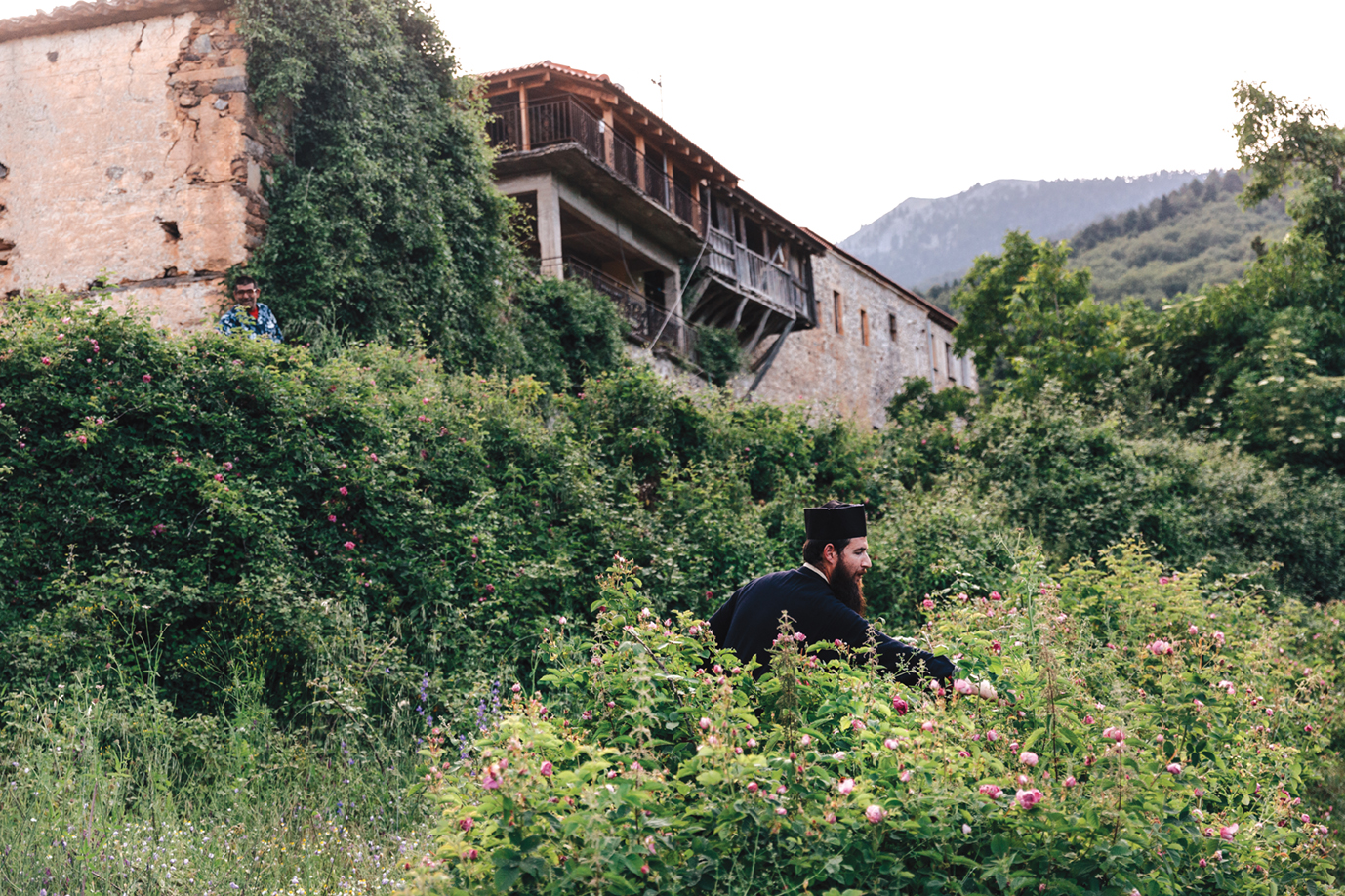



At the end of May we visited the Holy Monastery of Ayios Georgios in Feneos area to join the monks in the production of rose petal preserve, which is entirely made by using roses from the monastery’s gardens. It was a two-hour journey from Athens, through vineyards and meadows with beehives. We crossed stone-built narrow bridges to reach villages perched in lush green mountains close to the quaggy Stymphalia Lake and the vast Feneos valley, until we finally arrived at the beautiful Lake Doxa. This eco-touristic site of rare natural beauty and charm is also known as the “Corinthian Switzerland”, rightly so.
A strip of land inside the lake leads us to the church of Ayios Fanourios. Before assuming its current name, it was known as Palaiomonastiro, an old chapel attached to the monastery of Ayios Georgios. According to tradition, a monk from Kalavryta built Palaiomonastiro using both his own resources and money he collected from mendicity. When Feneos Lake inundated the whole valley, Palaiomonastiro was abandoned and a new monastery was erected farther up in the mountains. Even today, one can see the ruins belonging to the initial monastery, at the southern part of the church.
Only a few minutes distance from Lake Doxa, the new Holy Monastery of Ayios Georgios overlooks the whole area from an altitude of 1.000 meters. This monastery has a vast history and played a key role in the area during the 1821 Greek War of Independence or, as the Greeks call it, the “Greek Revolution”. The monastery was used as the headquarters of the “Filiki Eteria”, or Society of Friends, (a secret organization founded in 1814 in Odessa, whose purpose was to overthrow the Ottoman rule of Greece and establish an independent Greek state )which had the support of Father Superior Nathanael and neighboring monasteries. Today, visitors see an impressive three-storey monastery built in 1693 and refurbished in 1754, due to damages caused by an extensive fire.
Father Athanassios is a pure soul and a very hospitable man who welcomes us to the monastery. Though very young – barely 31 years old – he has been a monk for 8 years already, hailing from the coastal village of Assos in the area of Corinthia.
A short, introductory tour gets us all hyped about a wonderful experience. We stayed in the monastery for 36 hours and kept to its program. Apart from Father Athanassios, Hieromonk Gennadios, the Father Superior is the other monk residing at the monastery.
We leave our personal belongings in our cell-guestroom and we are then guided in the interior of the building. From the tiled courtyard, we climb the outside stairwell leading to the upper floors. Storerooms and auxiliary rooms are situated on the ground floor. The monks cells are on the first floor and the kitchen, dining room and the monastery’s parlor, with a balcony that looks out to an amazing view of the lake, are on the second.
The catholicon of the monastery, devoted to Great-martyr and Trophy-bearer Ayios Georgios, is situated in a prominent position in the heart of the monastery. While crossing the gate with the bas-relief of Ayios Georgios, we observe the interior of the domed basilica, which is divided in three sections: the narthex, the nave (with three aisles) and the altar.
According to Father Athanassios, “the whole church is decorated with frescoes of rare beauty and fine craftsmanship, painted during the period 1762-1768 by Panayiotis, a painter from Ioannina. These frescoes are influenced by the Cretan School of icon painting and are characterized by their outstanding expressiveness and vividness”. The Pantocrator (Christ represented as the ruler of the universe, especially in Byzantine church decoration) is equally impressive, however our gaze is captivated by the large wooden chandelier carved after the Mount Athos style, decorated with miniature icons of saints of exceptional artistic quality.
The wood carved templon of the catholicon was created in 1762 and was gilded in 1768. It bears images and representations of the Old and New Testament, the 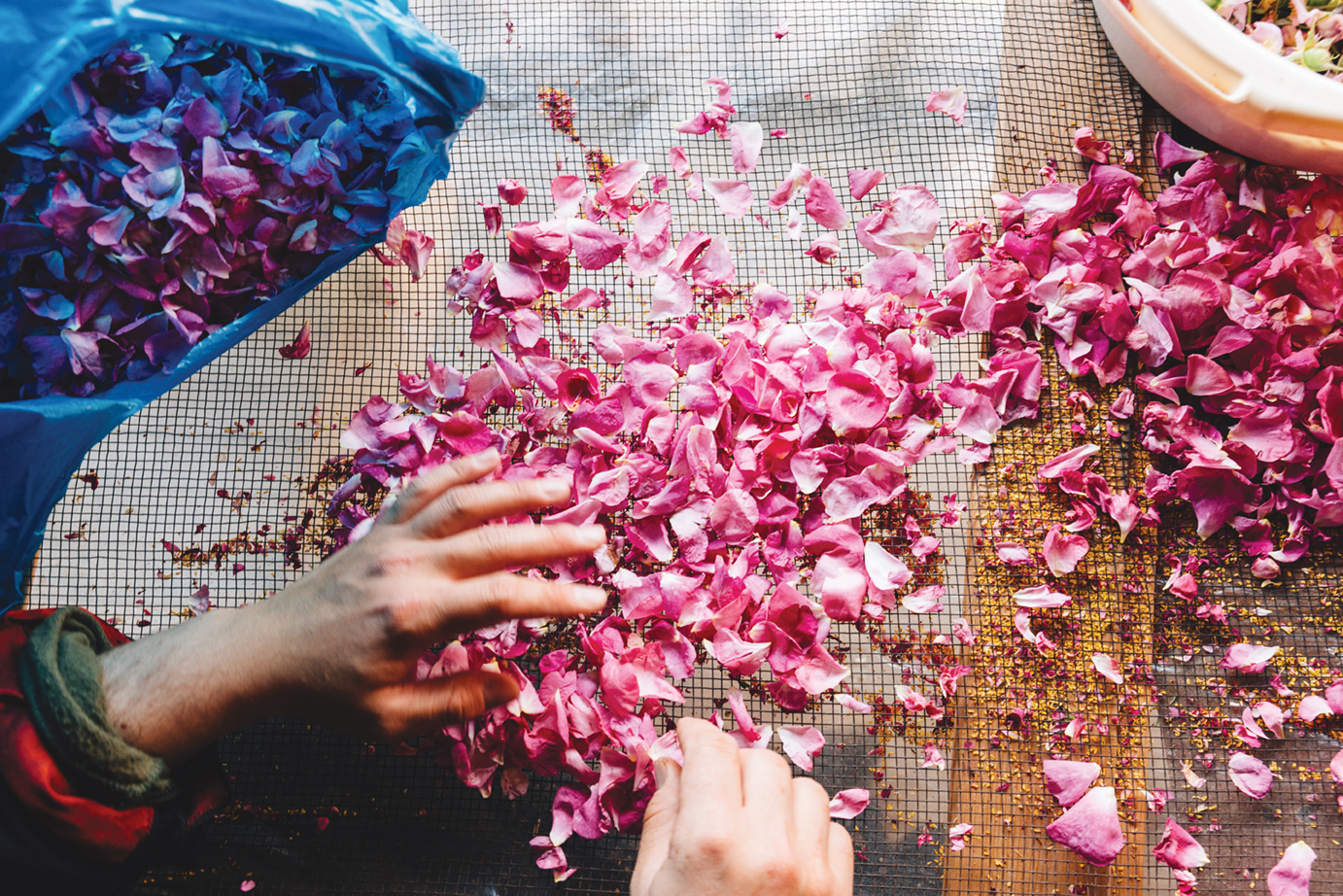 Dodecaorton (the twelve important Great Feasts of the liturgical year) and the martyrdom of Ayios Georgios.
According to Father Athanassios, “a new building was added at the westernmost part of the church, which had a trap door leading to the hidden room used by monks as a secret school for the Orthodox children, during the Ottoman rule. Visitors may indeed use a tiny staircase to visit this pristinely preserved space.
Throughout the year, the two monks are occupied with farm work, the maintenance of the monastery and provisioning. Furthermore, the monastery supplements its income with the proceeds of the sale of rose petal preserve, visitor contributions and timber from monastery-owned forests.
It is noon and the monks eat at about one o’clock. We dine at a small kitchen overlooking the green forest. “You will enjoy the miracle of simplicity, here”, Father Gennadios says. Indeed, a plate of okra and potatoes, a tomato salad, feta cheese, altar bread and red wine are the ideal introduction to monastic gastronomy. A prayer is said at the beginning and at the end of the lunch and approximately twenty minutes later we all retire to our cells, so as to rest for a while.
 Two single beds, sheets, icons of Ayios Georgios, ecclesiastic books and a window offering breathtaking views of the lake are all the amenities of the whitewashed cell our hosts have prepared for us. In the afternoon, we take a stroll in the rose gardens surrounding the monastery. The cultivation of roses is not deemed hard, in general, but it requires great attention, when it comes to weeding the rose beds, in order to protect them from weeds and pests.
The monks share stories from the Greek Independence War and the German Occupation during WWII and, of course, they show us photos from the rose petal preserve production. This always takes place between the end of May and beginning of June, depending on weather conditions and the rose petal harvesting lasts from 5 to 20 days.
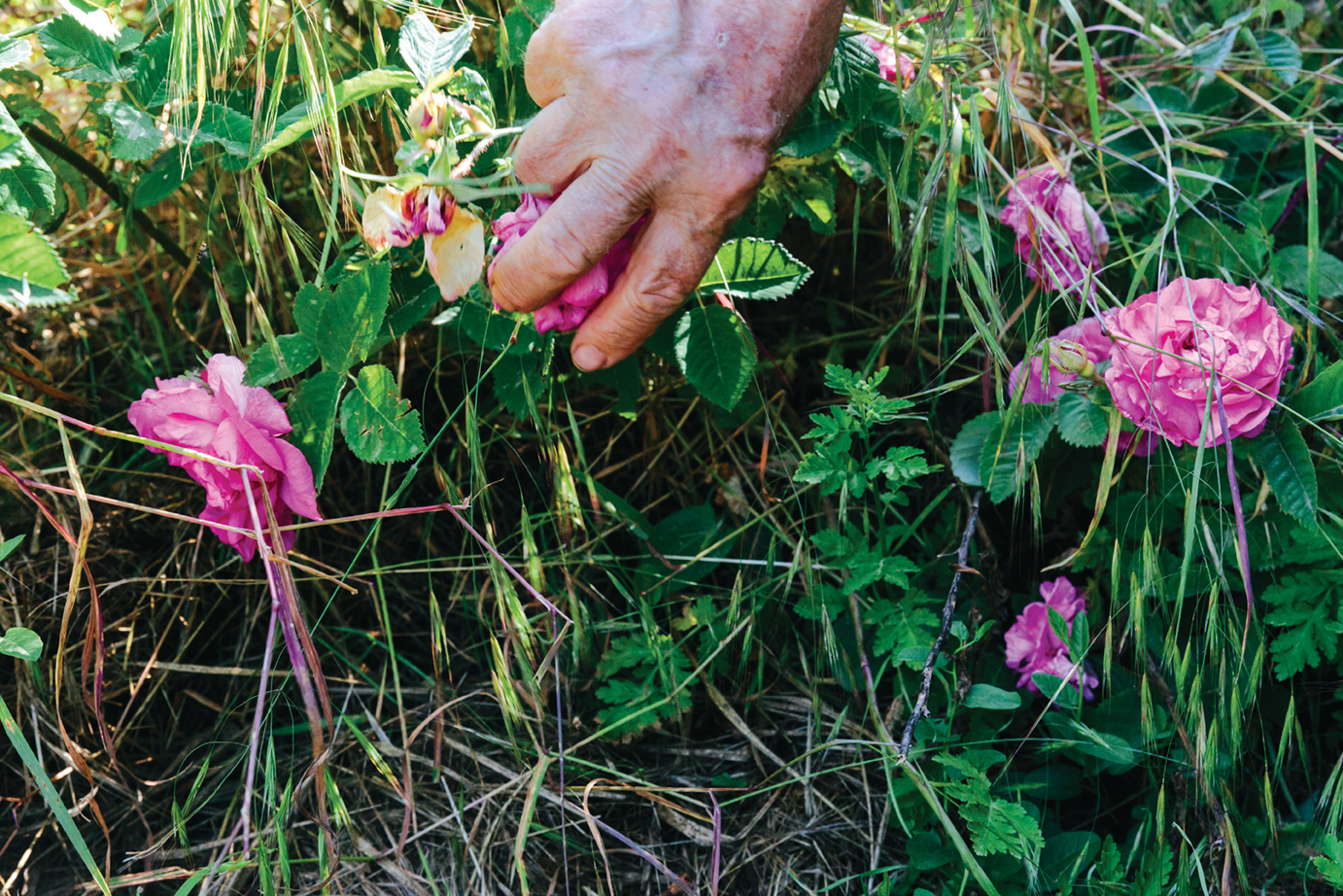
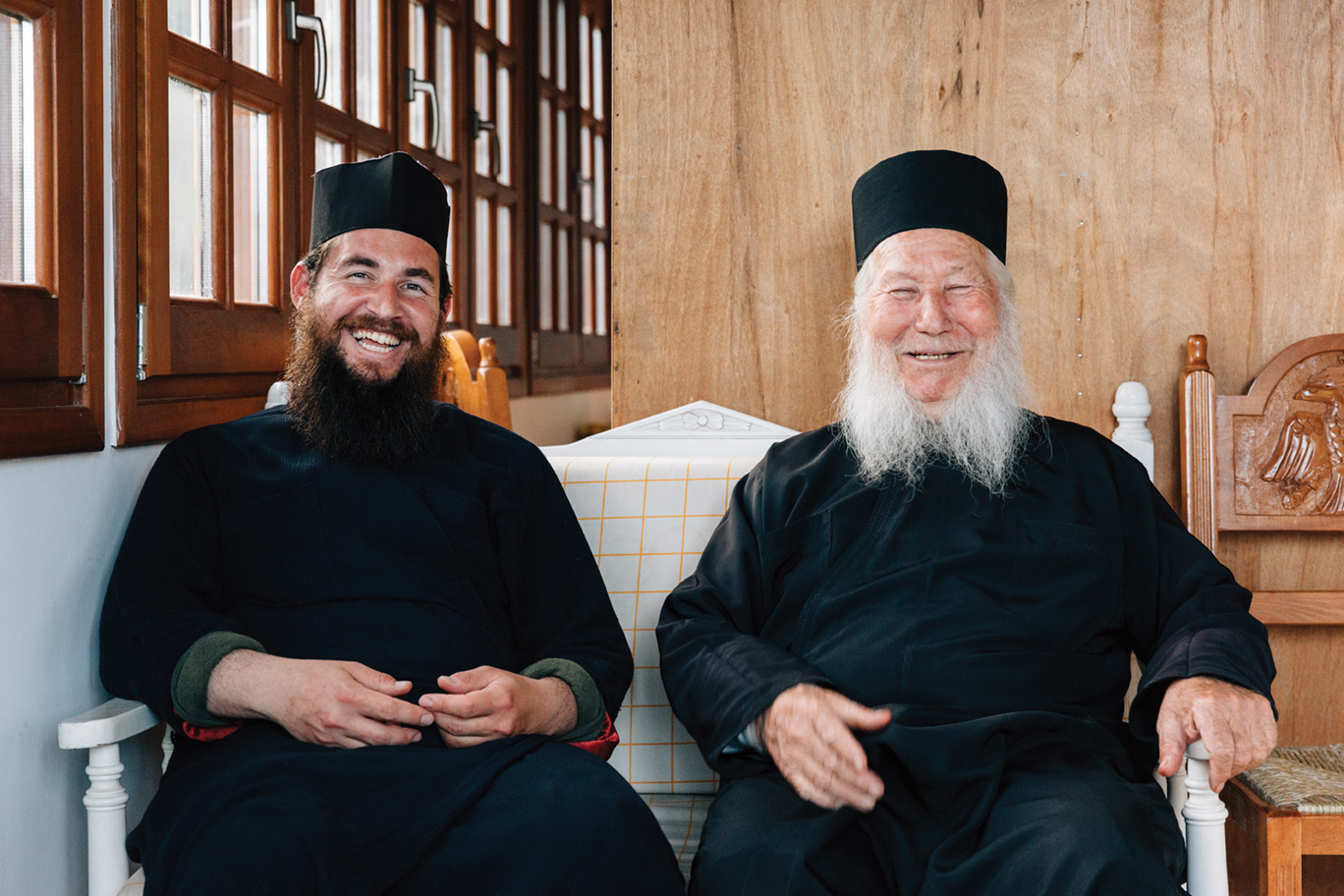
 Aged 78, Hieromonk Gennadios has spent the last thirty years of his life here. He is a humble, soft-spoken and sweet man with a characteristic monastic figure. Smiling proudly, he informs me that he was the one who initiated the production of rose petal preserve. “Roses are a timeless symbol of spring. They represent eternity and the renewal of life, blooming after a cold winter. Roses were always important for Christianity, symbolizing Paradise and Heavenly Bliss”, he says. I ask him about the specific cultivar that grows here and he answers that “it is the Magiatiko (of May) Peloponnesian rose. It offers an impressive show of pink flowers, during its rather short blooming period, while being extremely resistant and it gives off an intense fragrance, thanks to its delicate pink petals”. Its latin name is most likely “Rosa Centifolia”.
 Hieromonk Gennadios recounts to me how he was the one who brought the first roots of Magiatiko rose variety from the Monastery of Taxiarches in Aigion, many years ago. He then spent many years in Mega Spilaion Monastery, where he learned how to make rose petal preserve. “They used to offer Turkish delights and water to pilgrims, here. When I brought the roots, I planted them around the monastery. They bloomed and multiplied and this resulted to the offering, production and selling of rose petal preserve”, he indicates.
Interesting discussion makes time fly and as soon as we finish supper, it is already time for vesper. The sanctity of the place, combined with the grandeur of nature, creates a mystical atmosphere. Inside the church, the dim light, sweet smell of incense, the light of candles, the lyrical chanting provoke feelings of intense awe.
 A little later, Father Superior gives the order to retire. The undisturbed silence is only broken by the meowing of several cats, which roam freely in the monastery. The images, sounds, impressions and stories linger in your mind.
At six in the morning, Hieromonk Gennadios rings the Talanton, a wooden instrument, calling everyone to wake up and participate in their holy duties. A few minutes before entering the church for the matins, the old monk reminds me that “like Noah, who sounded the signal on a plank of wood, summoning the animals into the ark, so as to avoid the pending destruction by the Cataclysm, in monasteries the talanton symbolizes the time of prayer in the New Ark, the church of Jesus Christ. Likewise, those answering this call will be saved by the cataclysm of sin”.
At the end of the matins, traditional Greek coffee is served, brewed by the calloused hands of Hieromonk Gennadios, always with a bit of sugar and some milk.
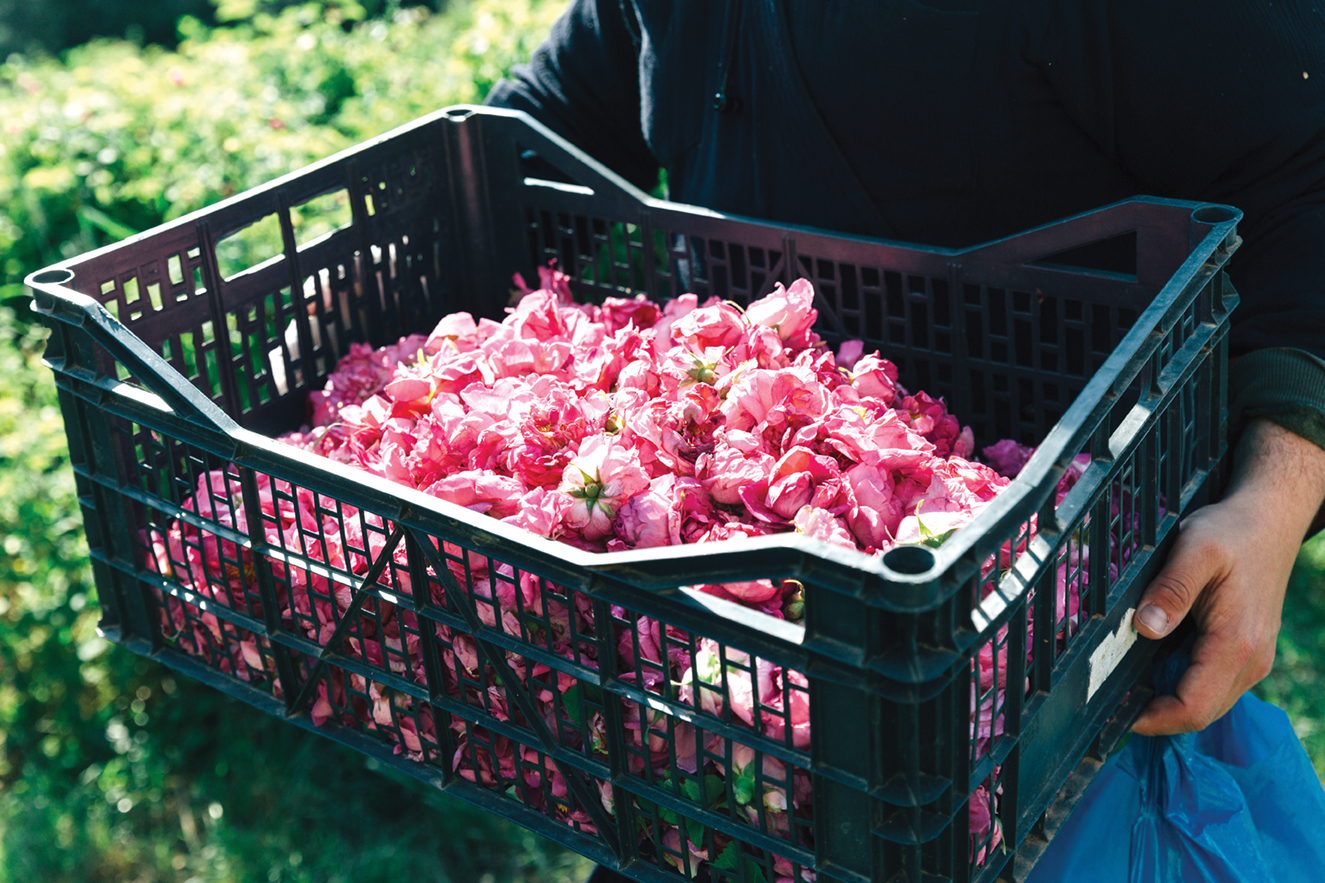
 Our second day is entirely devoted to the production of rose petal preserve. The weather is ideal and we start by harvesting rose petals around the monastery. Carrying wooden crates for the open rose petals, we walk along the rose beds. Birds chirp and bees fly around us, while we marvel at the cherry and sour cherry trees, chestnuts, pears, pines and firs. As soon as we’re done, we pay a visit to the new rose garden, situated by the lake, approximately one kilometer away from the monastery. It will be ready in three years time, but the first roses have already blossomed. While we gather more rose petals, horses, turtles and shorebirds enjoy the valley as much as we do.
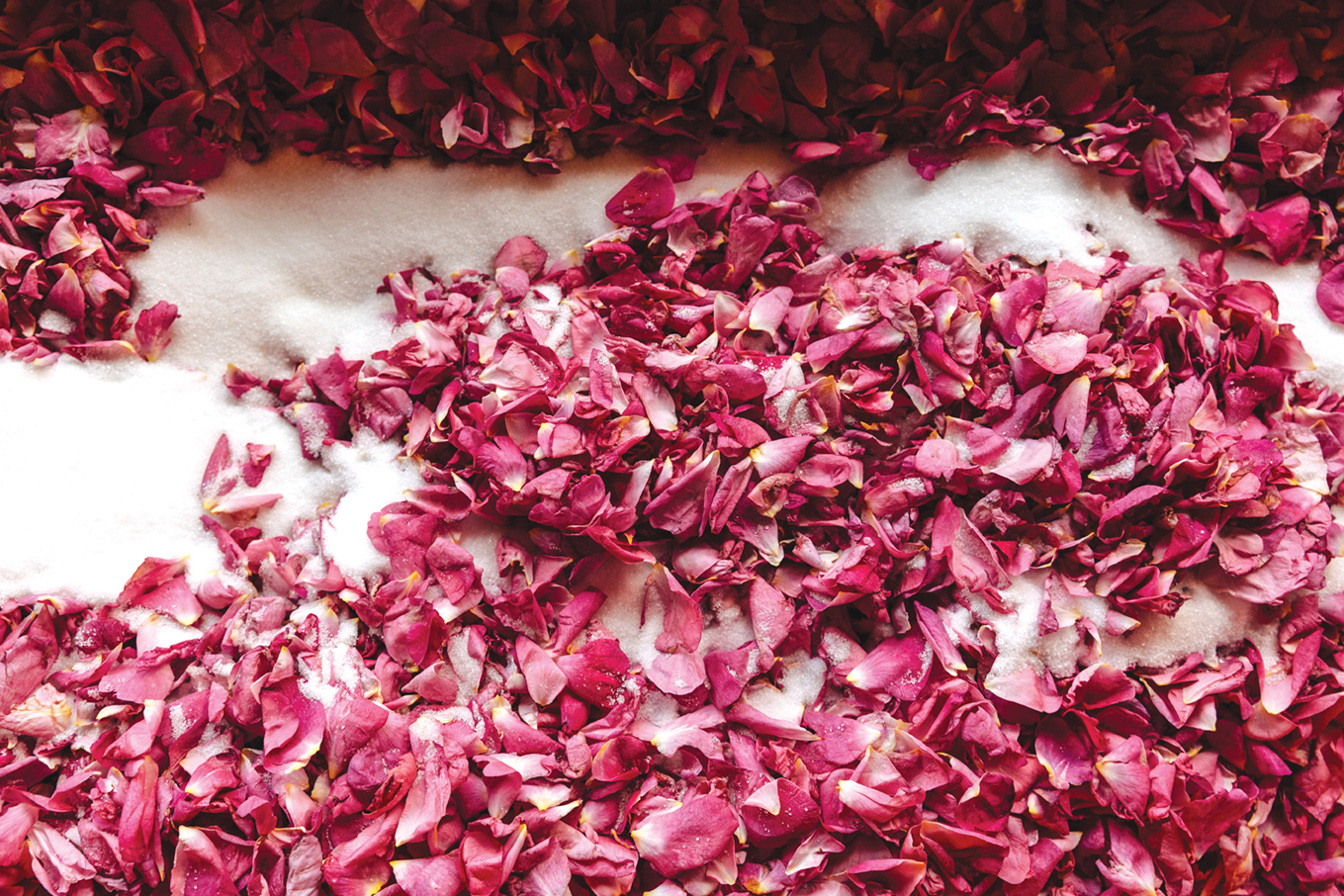
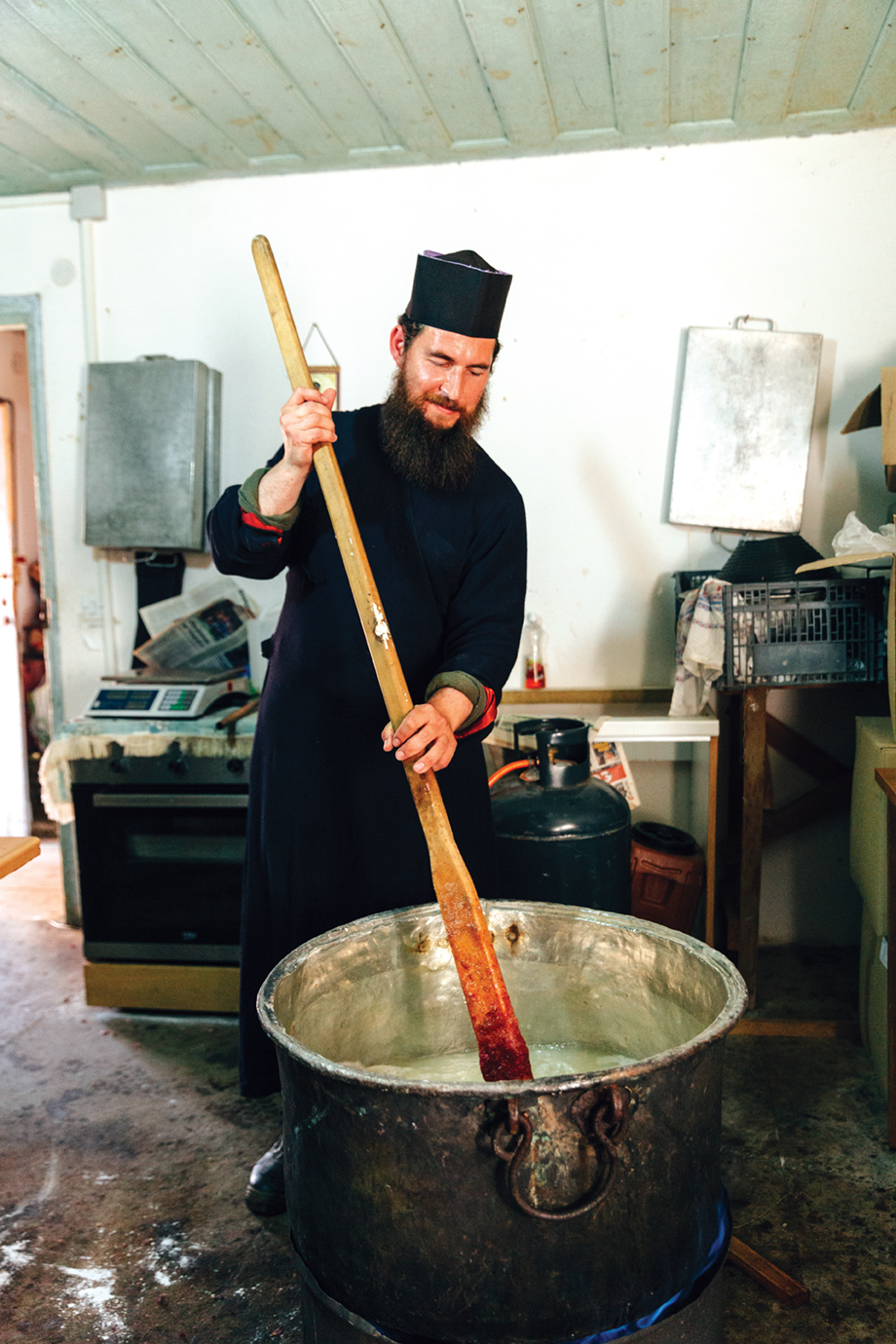
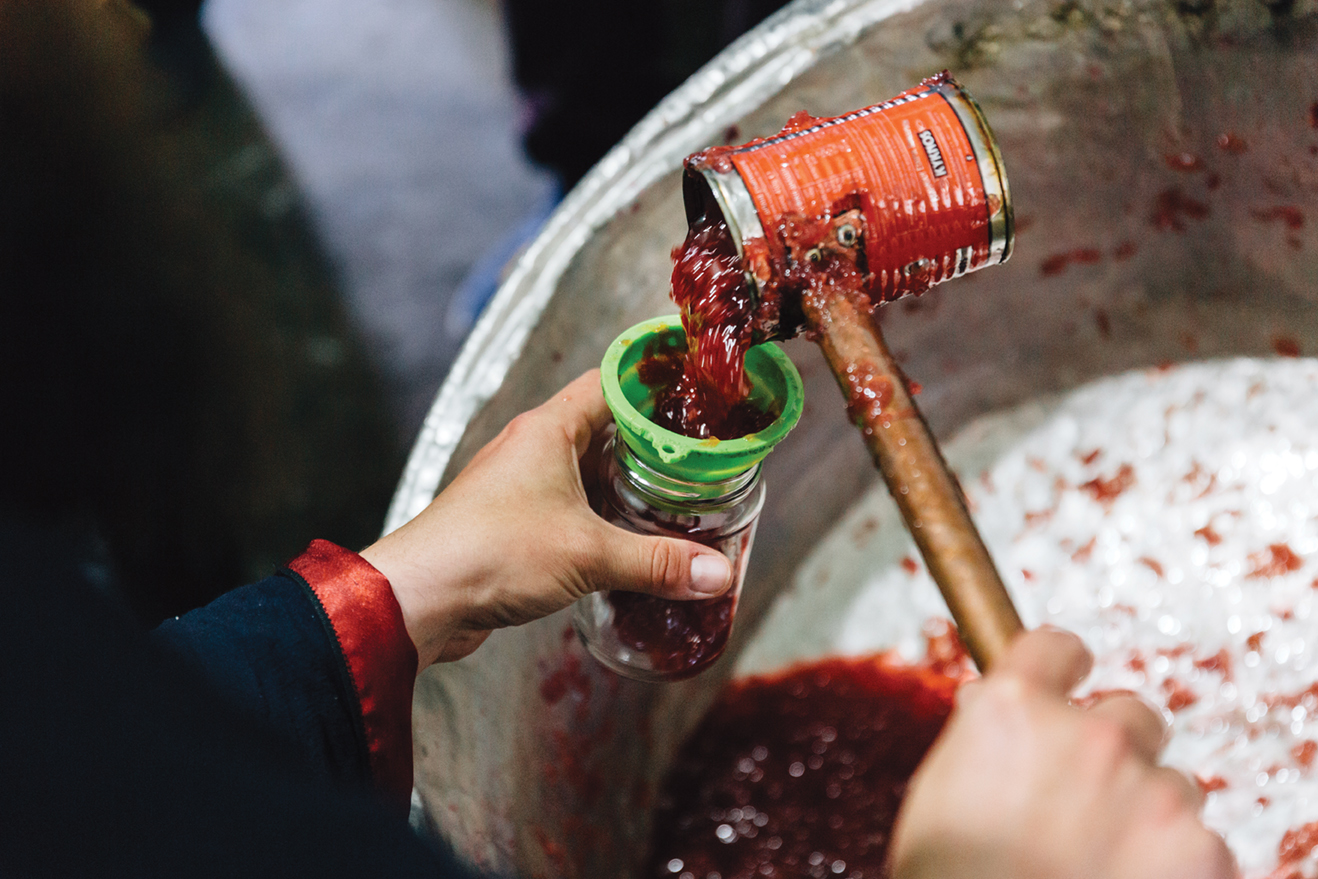
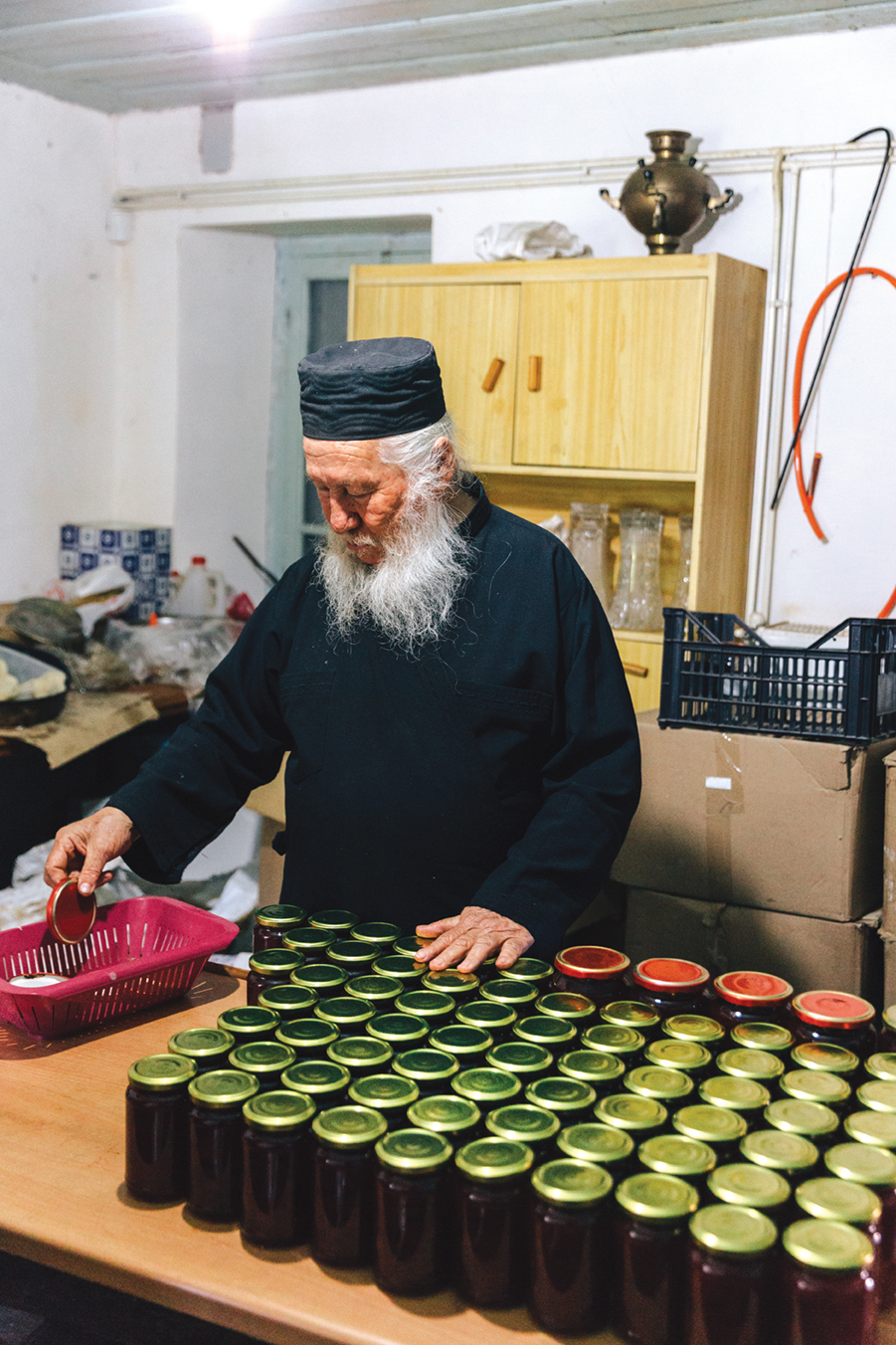
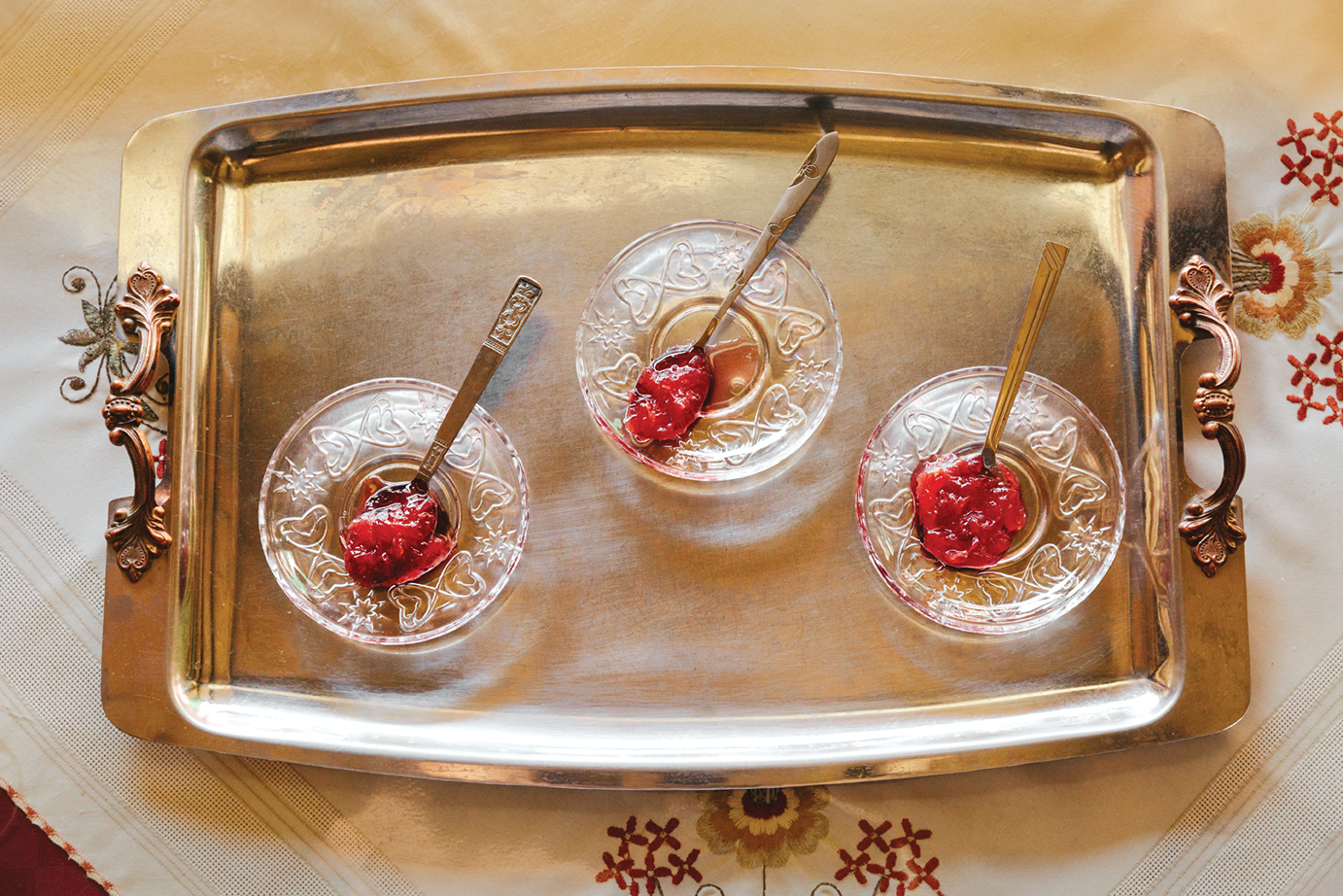
Back in the monastery, the next phase starts by emptying our crates in two large sieves positioned on the wooden verandah of the second floor. As soon as the 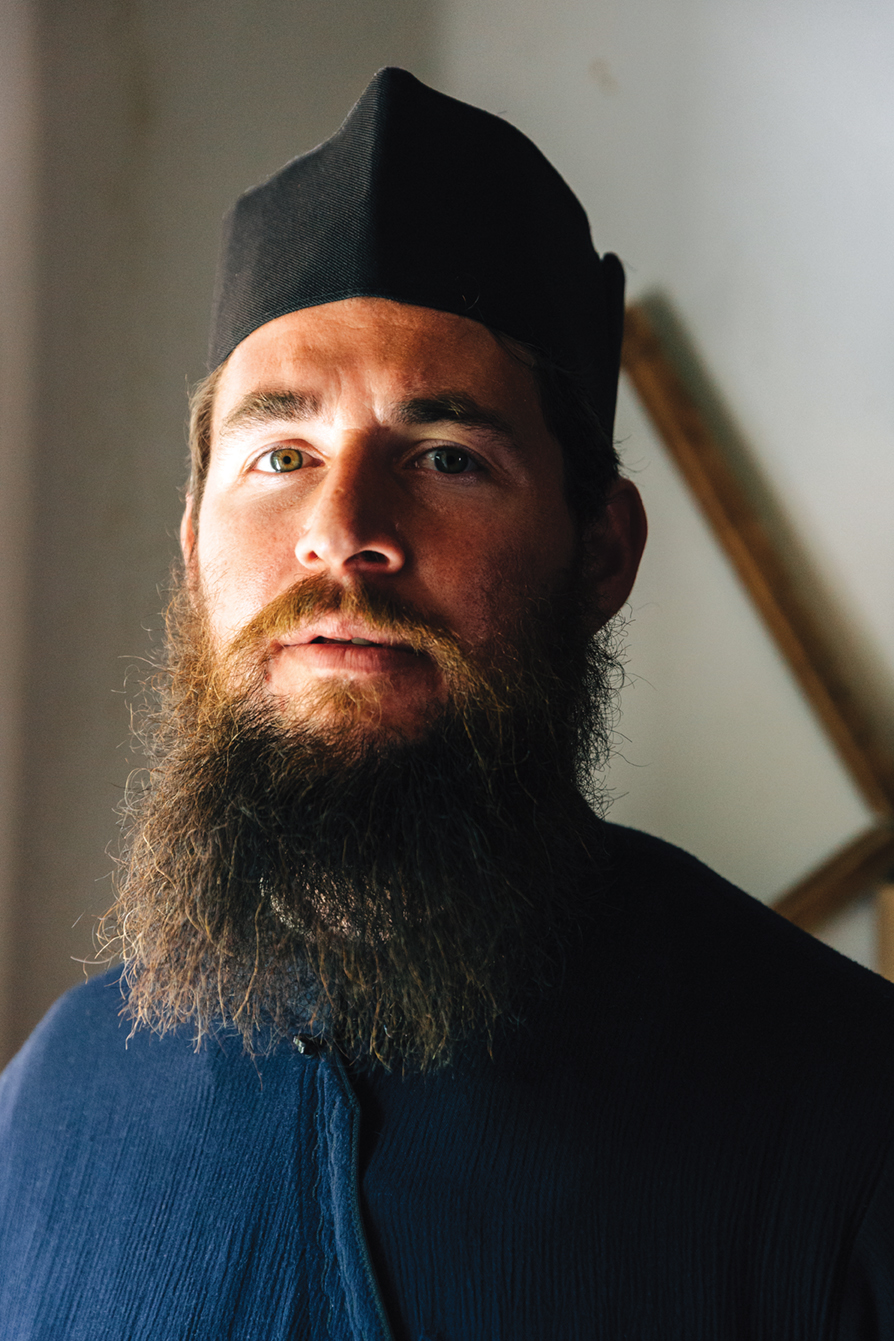 rose petals are spread, they are thoroughly cleaned and the stems and stamens are removed. Rose petals are then placed in large, clean bowls. “We knead the rose petals using copious amounts of sugar. The whole process requires strong arms, since, as you see, we do not add any water to the mixture at this stage, and sugar melts thanks to the water contained in the rose petals, Father Athanassios says, while kneading with rolled-up sleeves, until sugar and rose petals become a uniform paste. We enter a small room used for the preparation of the sweet and he grabs a blackened pot, which he halfway fills with water. He lets the water boil at a high temperature and adds the necessary amount of sugar. Indicatively, the analogy is six to one; for 1 kg of petals, 6 kg of sugar and 3 kg of water are required. He adds the mixture and ten minutes later, as the sweet “sets”, he adds some lemon juice. As he stirs, using a large wooden spoon the fragrant vapors fill the monastery halls. The preserve is then set aside to cool. In the afternoon of the same day, we help packing the rose petal preserve in sterilized jars. Father Athanasios stands next to the pot and he starts filling the jars with exactly the same amount of finished product with a handmade utensil. Then, Gennadios seals the containers and places them in a cart, so that they will be transported outside and splashed with water under the sun, in the end. When the jars are dry, we place the labels and the preserve is sampled. Sitting at a table outside, we open one of the jars. Spring flavors lash out and we taste this unique, fragranced syrupy sweet.
The sun sets and it is time to leave. Before saying goodbye, Hieromonk Gennadios, sitting upright in a wicker chair on the wooden verandah, tells us: “when I first came here and for about a month, I couldn’t get enough of the natural beauty of the place. Then, the power of its image started to fade. However, its spiritual power never faded. Desires change and the soul rests. One learns to forgive, believe and hope”.
Leaving this important ecclesiastic monument behind us, we feel that all of our senses were indulged. This was a delightful journey into color, flavors and the fragrance of the rose gardens of the Monastery of Ayios Georgios. Father Gennadios words still ring in my ears: “May your life always be sweet, like a rose”.